
MIDAS focuses on cultivating industrial crops for bio-based products on marginal lands. A core objective of our work is to demonstrate low-input agronomic practices that significantly reduce water needs while boosting crop productivity in water-stressed regions.
As part of these activities our partner CREA-IT has validated the use of a machine for the deployment of a Subsurface Water Retention System (SWRS) in operational environment at two MIDAS case studies, in Spain and in Italy. While the concept of subsurface barriers is known, the lack of specialized machinery has historically hindered its large-scale adoption. To bridge this gap, CREA-IT has developed a prototype agricultural machine designed to mechanically install impermeable membranes up to 1 meter deep in sandy soils. By installing the membrane deep under the root zone, the SWRS creates an underground reservoir that physically stops water from being lost to deep percolation—a common challenge in sandy and porous soils.
In Spain CREA-IT and ITAP collaborated to deploy the SWRS in a Guayule plantation in Fuentidueña de Tajo, Spain. In this trial, researchers validated the system using Guayule across two densities (20,000 and 40,000 plants/ha). The experimental plot spans across a length of 120 meters, providing a substantial test area for controlled observations. The SWRS lines are spaced at 3 meters and 9 meters apart, allowing isolated observation of each SWRS line’s effect on soil and guayule crop performance. By installing an impermeable membrane deep under the root zone, the SWRS creates an underground reservoir that physically stops water from being lost to deep percolation—a common challenge in sandy and porous soils.

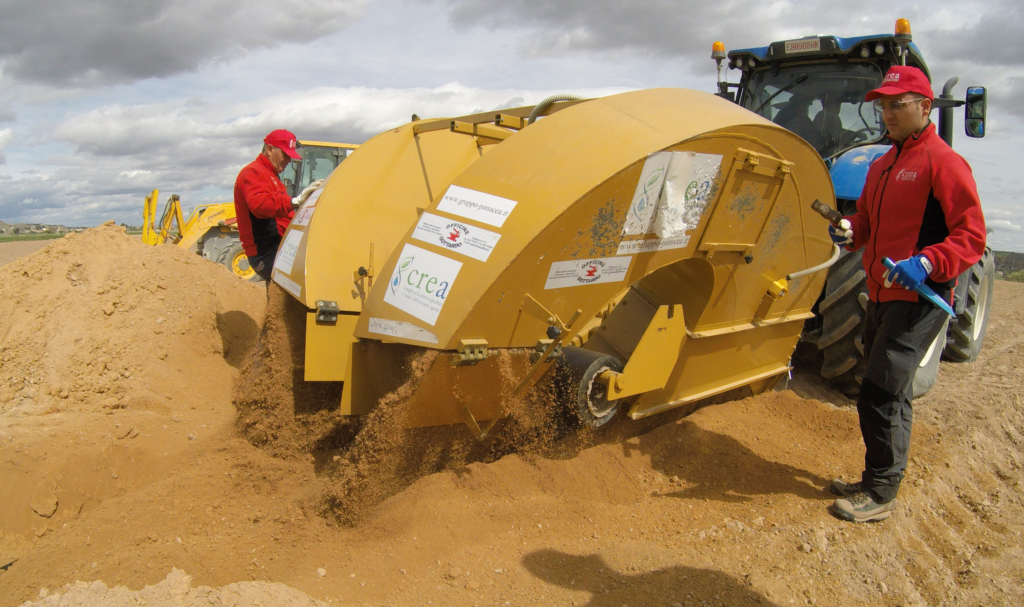
By utilizing soils probes and multispectral drone monitoring, the team tracked soil moisture and Normalized Difference Vegetation Index (NDVI) dynamics over a full growing season. Sensors positioned directly above the membrane retained higher moisture levels than the ones placed at distance. The results confirm that the SWRS system creates a zone of significantly higher soil moisture around the roots, particularly at a depth of 60 cm, providing a vital lifeline for crops during dry periods.
Another validation test is ongoing in Sicily in collaboration with the University of Catania, on annual crops including castor bean, sorghum and hemp.
🚀 The SWRS prototype is now featured on the Horizon Results Platform as an official MIDAS result. CREA-IT is open to collaboration with machine developers, investors, research organizations to further develop and bring this climate-adaptation tool to the market. Explore the official result page and learn more about this technology here
